2014年5月12日星期一

The Typle and Introduction of Fiber Optic Connector

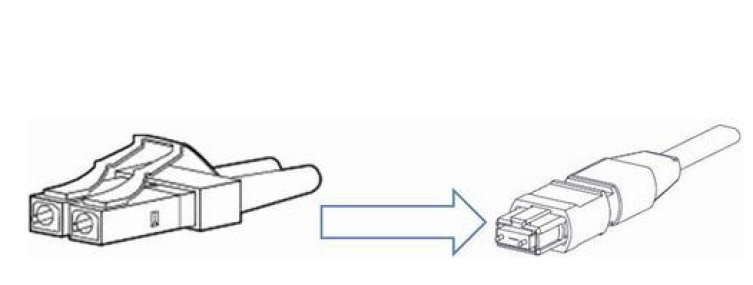
According to the different transmission, fiber optic connector can be divided into singmode and multimode silicon-based fiber optic cable, and fiber optic cable in plastic transmission medium. According to the connector structure can be divided into FC,SC,ST,LC,D4,DIN,MU and etc. Wherein ST fiber optic connector is commonly used wiring device side, such as Fiber Optic Patch Cords panels, fiber optic module. While SC and MT connectors are typically used for network equipment side. By the shape of the fiber end face, it can be divided into FC,PC(including SPC or UPC) and APC,according to the number of fiber core, it can be divided into singlecore and multicore (eg MT-RJ).Fiber optic connectors are widely used variety. In actual application process, we generally follow different fiber connector structure to distinguish it. The following are some of the more common optical connector:

FC fiber optic connectors: Strengthening way is to use an external metal sleeve, fastening means for the turnbuckles. Generally adopt ODF side(Mostly used one the patch panel).
ST fiber optic connectors: Commonly used in fiber optic patch panels, rounded shell, fastening means for the turnbuckles.(Commonly used in fiber optic patch panel).
SC fiber optic connectors: Connected with GBIC optical modules connector, its casing is rectangular, fastening means is a latch type using pin plug, do not need to rotate.(Mostly used in Switch Router).
LC fiber optic connectors: Connected with SFP module connector, it uses easy operation made modular jack (RJ) latch mechanism
MT-RJ:Square transceiver fiber optic connectors, one pair of fiber transceiver.

Several common fiber jumpers:
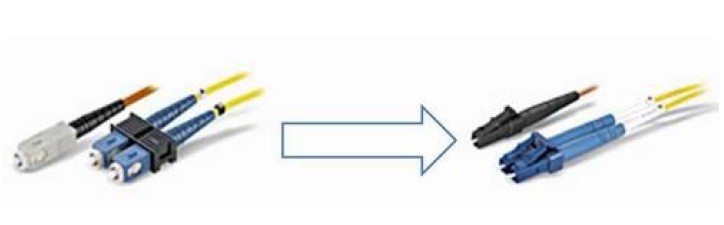
Sc to Lc Fiber Patch Cable
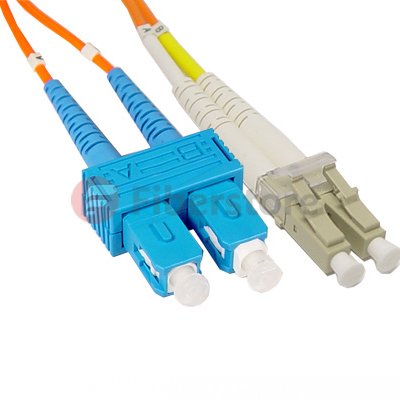
sc to lc

Features
*Connector Type: SC-LC
*Polish Type: UPC
*Core Size: 100/140um
*Large bandwidth and Low attenuation
*High return loss and low insertion loss
*Factory terminated for superior performance
*Good interchangeability and duplication *Allow 10 Gig / second link distances of up to 550m
*Custom fiber optic cable lengths and jacket colorsInsertion loss testing performed on every assembly
*Available in simplex or duplex with a wide variety of connectors *Meets or exceeds industry standards for Return Loss and Reflectance *Huge stock, good packing, competitive prices and very fast delivery

St-Lc Fiber Patch Cable
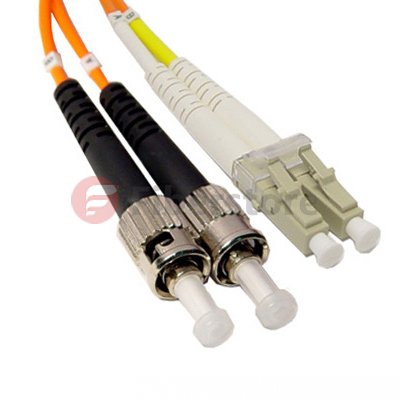
st lc

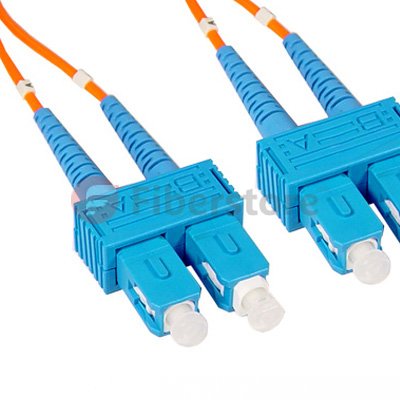
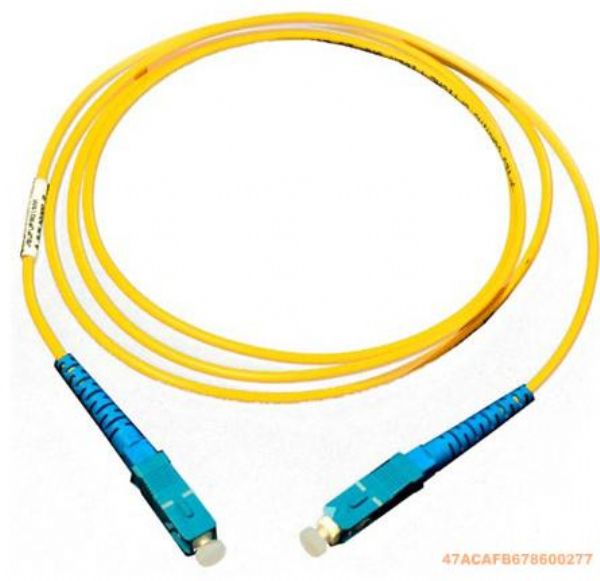
Sc to Sc Fiber Patch Cable

sc to sc fiber patch cable

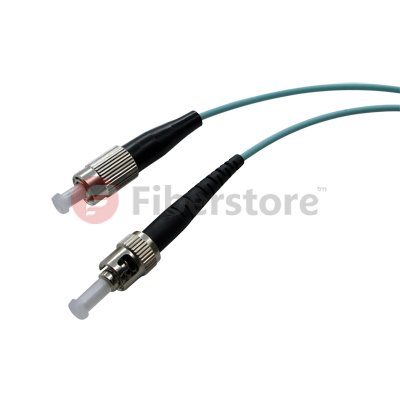
Fc-Sc Fiber Patch Cord

fc to sc fiber patch cords

The fiber jumpers from fiberstore use smaller concentricity error and inner diameter high-precision ceramic ferrule,as well provides additional insertion loss and return loss, in order to avoid damage to the transmission optical transceiver device. We use advanced technology and grinding equipment, ensure the grinding fiber center offset, depression and end radius of curvature of ceramic fiber. Our Technical parameters are in line with the required standards. Fiberstore ensure the long-term use of the connector, not only for the joints and back reflection attenuation test, but aslo the use of scratches or blemishes precision interferometer test the joint surface, measurements taken FC, ST, SC, LC and MU-type connector of the radius of curvature, ground offset amount of the optical fiber and the projecting amount of depression, in order to ensure the quality of the joint.

Fiberstore can be configured as single, dual core or multi-core, and different types according to customer needs. Our fiber products has different fire rating, providing design flexibility. Insertion loss, return loss, interchangeability, repeated mating performance, easy to use.

2014年5月11日星期日

The Basic Knowledge of Optical Fiber and Pigtail

How do fiber optic work?

Optical fiber communications composed of thin glass by the plastic protective overcoat layer. Glass essentially consists of two parts: the core diameter of 9 to 62.5μm, a low refractive index outer cladding diameter of 125μm glass material. Although according to the different materials used, there are some other types of fiber, but is mentioned here that the most common types. Light in the core portion of the fiber to the "total internal reflection" mode transmission, but also refers to the light entering end of the fiber, the interface between the core and the cladding reflected back and forth, and then transmitted to the other end of the fiber. Core diameter of 62.5μm, outer cladding diameter of 125μm fiber called 62.5/125μm fiber.

What is the difference between multimode and single-mode fiber?

Multimode Fiber Optic Patch Cables Almost all of the Multimode Fiber Optic Patch Cables dimensions are 50/125μm or 62.5/125μm, and the bandwidth (the amount of information transmission fiber) is usually 200MHz to 2GHz. Multimode optical transceiver via multimode fiber can be up to 5 km of transmission. In the light emitting diode or a laser light source.

Single Mode Fiber Cable

The size of Single Mode Fiber Cable 9-10/125μm, and compared with a multimode optical fiber, it has unlimited bandwidth and low loss characteristics. The single mode optical transceiver used for long-distance transmission, and sometimes up to 150-200 km. Using a narrow spectral line LD or LED as a light source.

Single mode fiber is cheap, but compared to multi mode fiber device, it is more expensive. Single-mode devices typically can run on single mode fiber, but also be run on a multi mode fiber, and multimode device only runs on multimode fiber.

How is the loss with using of the Fiber Optic Patch Cables?

It depends on the the wavelength of the transmitted light and the kind of optical fiber:
When 850nm wavelengths for multimode fiber: 3.0 dB / km
When 1310nm wavelength for multimode fiber: 1.0 dB / km
When 1310nm wavelength for single mode fiber: 0.4 dB / km
When 1550nm wavelength for single mode fiber: 0.1 dB / km

Fiber Optic Pigtails

Fiber Optic Pigtails ony has one end connector, and the other end is an optical fiber core breakage, by fusion connected with other core cable, often appear in the fiber optic terminal box for connecting cable and fiber optic transceivers.

Fiber optic pigtails devide into multimode and singlemode fiber pigtails. Multimode fiber pigtail is orange and wavelength of 850nm, the transmission distance of 500m, for short-range connectivity. Single mode fiber pigtail is yellow, there are two wavelengths, 1310nm and 1550nm, transmission distance of 10km and 40km.

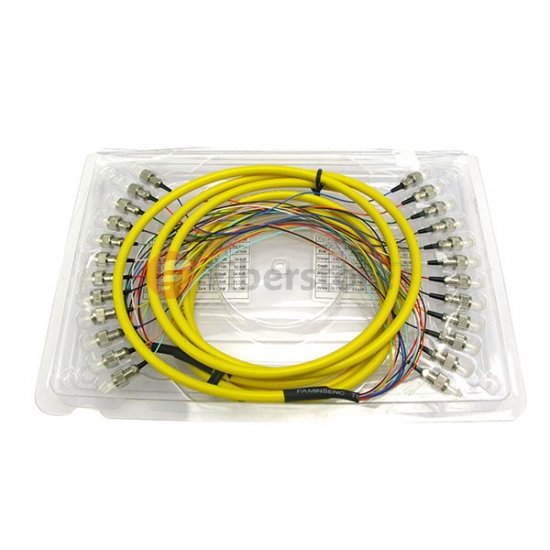
Fiber optic pigtail connector was devided into single mode and multimode by the mode of fiber optic cable; By overall structure can be divided into FC, SC, ST, MU, LC, F25, etc. By the end structures can be devided into PC、UPC、APC. Here are some fiber optic pigtails products in Fiberstore.com, as shown in figure:
 ingle-mode LC/SC/ST/FC Bunch Pigtail
Multimode LC/SC/ST/FC Pigtail
 Our fiberstore.com provide wide degree flexibility on fiber pigtails, including 9/125 single-mode, 62.5/125 multimode 50/125 multimode and 10G?50/125um OM3 types, simplex fiber, 4 fibers, 6 fibers, 8 fibers, 12 fibers, 24 fibers, 48 fibers and so on.These fiber pigtails can be with fan-out?kits and full compliant to Telcordia, EIA/TIA and IEC standards. Welcome to our store to know more information. 

2014年5月8日星期四

The Instructions of Armored Fiber Jumpers

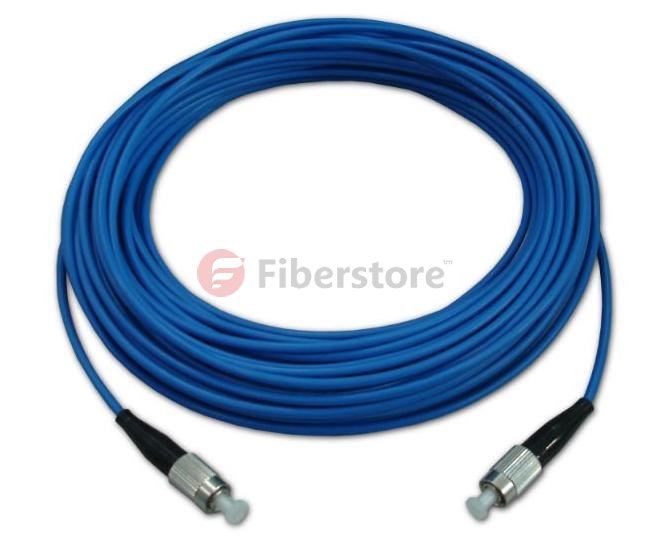
The Classification of Fiber By transmission method, fiber optic cables mainy are divided into two categories,they are single mode fiber and multimode fiber. Armored fiber optic jumpers in blue is?Single Mode Fiber Cable, the transmission distance is long. Armored fiber optic jumpers in blue is Multimode fiber optic calbe,the transmission distance is short. fiberstore.com
Armored fiber optic jumper connection All fiber ports are two switches, which are pitch-catch, armored Fiber Optic Cables must be two. When the switch cascade through the fiber port, you must reversed the both ends of armored fiber optic transceivers, when the end of the "receive", the other end "send". Similarly, when a termination "send", the other end "receive".

The types of armored fiber optic jumpers and fiber port Armored Fiber Jumper are devided into single mode fiber and multimode fiber. Fiber port switches, fiber optic calbe must be consistent with the used cabling, that is if cabling uses multimode fiber optic cable,the fiber interface switches must perform 1000Base-SX standards, must also use the multi mode armored fiber jumpers; If you are using single mode fiber cabling, then the optical interface switches must perform 1000Base-LX/LH standards, must also use singlemode armored fiber jumpers. multimode armored fiber
It should be noted that there are two types of multimode fiber, that is,62.5/125μm and 50/125μm. Although fiber optic switch ports are identical, and both are also executive 1000Base-SX standard, but armored core diameter fiber jumpers must be identical to the diameter of the cable core, otherwise, would lead to connectivity problems.

In addition, the type of interconnected fiber ports must be identical, or both multimode fiber ports, or both single-mode fiber port. One end is a multi-mode fiber ports, while the other end is a single-mode fiber ports, it will not be connected together.

Armored Fiber Jumper Precautions

The wavelength of light armored transceiver modules at both ends of the fiber jumpers must be identical , that must be the same at both ends of the fiber wavelength optical module, a simple distinction is the color of the light module to be consistent.Generally, the short optical module uses multimode fiber; long wavelength uses multimode fiber module to ensure the accuracy of data transmission.When using optical fiber, do not bend over and circling, this will increase the light attenuation in the transmission process.After using armored fiber optic jumpers, must use protective sleeve protected fiber optic connector, dust and oil will damage the fiber coupling.

Acronyms
SFP: Small Form Factor Pluggable
SFF: Small Form Factor
XFP: 10 Gigabit Small Form Factor Pluggable
MU: Miniature Unit
LC: Lucent Connector
SC: Subscriber Connector
FC: Fiber Connector
MTRJ: ‘MT’ ferrule, Register Jack latch
ST: Straight Tip

2014年5月7日星期三

The Development and Benefits of Multi core Singlemode Fiber

1.

The development of multi core single mode fiber A typical optical fiber is single mode fiber structure, the outer cladding / inner cladding surrounding the core constitutes a waveguide. A common multi-core optical fiber includes a number of cores ,and each core have their own single-mode optical fiber inner cladding .Thus, each core is an fiber optic of the waveguide , i.e.,one singlemode fiber optic cable's function is be equal to a plurality of single core fiber . The obvious advantage of this fiber is low cost, low production costs of about 50% compared with ordinary fiber. In addition, Fiber optic cables can increase integration density , but also can reduce construction costs. Back in the late 1970s , foreigner proposed the idea which use multi-core optical fiber manufacturing high density fiber.However , because of the imperfect manufacturing technology , fiber affected by the residual stress , low mechanical strength , poor reliability, has not developed into practical and commercialization .Into the 1990s , fiber optic communication in the FTTH ( fiber to the home ) development has encountered higher cost of obstacles, and the intense competition in the copper.To overcome this obstacle , we must significantly reduce the cost of fiber optic cable manufacturing , and requires the development of high-density large armored fiber optic cable, in order to facilitate the laying of fiber optic cable and reducing installation costs . Thus, in 1994 , France Telecom proposed a new concept of multi core single mode and design a 4 core single mode fiber. In July 1994 made more than 100 kilometers Single Mode Fiber Cable, and use different core and structures fiber optic cables and non-fiber ribbon cable into the cable experiment. Compared with the common Single Mode Fiber, the cable density increase many times . Initially confirmed that the proposed multi core single mode fiber can reduce manufacturing costs while addressing the fiber optic cable and the development of high- density optical fiber optic cable. Since then, France Telecom and Alcatel have carried out a 4 core single mode optical fiber research and development , studyed from optical design, preform manufacture , drawing techniques , optical properties, a 4-pin cable, and mechanical connections from each a core of separation and termination of ordinary single-mode fiber and other aspects of a comprehensive. Currently, the cost per meter per core for $ 0.03 , while the cost per meter of ordinary single-mode fiber is $ 0.055. We can say that multi-core single-mode fiber forward practical development. This article focuses on the structure of multi-core single-mode optical fiber design, manufacturing processes and fiber properties, but also a brief introduction to the new fiber optic FTTH applications in the technical and economic advantages.

2.

Design of multi core singlemode fiber To meet the needs of FTTH systems. The design of multi-core fiber should meet the following key requirements: 1.31 um and 1.55um wavelength dual-window work; Crosstalk between each core is greater than -35 dB: precise geometry; Easy identification of each core and ordinary Single mode Fiber Optic Cable. Further, since the optical fiber length shorter in FTTH network (≤ l0 km), so the requirements for dispersion and attenuation of the fiber is relatively relaxed, there are strict requirements on bending and microbending losses. Each of the core are respectively located on the vertices of a square, the center of the square is the central axis of the multi core singlemode fiber. Each core is a single-mode optical fiber waveguides, cutoff wavelength 1.3 um.In order to reduce the bending loss and crosstalk, reinforce fiber molded capacity constraints, therefore compared with the conventional G652 optical fiber, the refractive index difference has increased. 3 core is a simple step structure, a refractive index difference 0.0062; another annular core refractive index profile, the refractive index difference 0.0l, this core is provided in order to facilitate identification of each of the cores.

The main advantage of multi-core Single Mode Fiber Cable

1. Attenuation coefficient By the testing and research of nearly 200km long fiber , the attenuation coefficient of the multi core singlemode optical fiber reached levels close to the corresponding single core fiber.

2. Bending and micro-bending loss characteristics Bending and microbending loss characteristics of the multi-core single-mode fiber optic is good, negligible additional loss introduced. This is due to the higher refractive index and limit the ability of a strong mold. Multi core single mode fiber optic in the l310nm and 1550nm wavelength mode field diameter was 8.4 ± 0.21un and 9.75 ± 0.25um, slightly smaller than the ordinary single mode optical fiber.

3. Crosstalk characteristics To 30 g of tension around 15 cm in diameter optical fiber on ferrule l0 km optical fiber with characteristic measurement, crosstalk between each core at l 310 nm wavelength, less than-70dB; at 1 550 nm wavelength, less than a 50 dB, are excellent -35 dB in the required index. Even slim to the 30 km, between 0-30g tension variations, changes, crosstalk is also only a few dB.

4. Mechanical strength Wth 10m length test, the average intensity of 70N. The conventional 125um fiber diameter of 60 N, it is because a large cross-sectional area of multi-core single-mode fiber. Fracture stress 4.6 GPa, 94% for the conventional 125 um diameter fiber.

2014年5月6日星期二

The Development and Application of MPO/MPT Multi Core Fiber Connector

MPO / MTP high density fiber optic connection system currently used mainly for three pre areas: Application of high-density data center environments,application of fiber to the building, application of internal connections in the splitter, 40G, 100G SFP, SFP + optical transceiver equipment, etc. This article highlights why the data center use MPO / MTP high density fiber optic cables connection system and how choose these high-density fiber optic connection system.

In communications, data transmission field, the development of fiber optic connectors is more prolific than copper connectors. According to incomplete statistics, so far, fiber optic connectors developed hundreds of different kinds, but only a dozen can widely use. Fiber optic connector has two distinct stages of development. The first stage, to save space, develop to miniaturization, the fiber optic connector is from traditional FC, ST, SC connectors to LC,MTRJ. sc fiber patch

The second stage, it is not only to save space, but also to meet the requirements for use of multi-core, fiber optic connectors evolved from LC, MTRJ, E2000 to MU, MTP/MPO, now an MTP / MPO connectors can meet the 2 core, 4 core, 8 cores, 12 cores, 24 cores, up to 72 core requirements.
 Fiber optic  patch cord

It is the last few years that MPO MTP Fiber pre-connected system use in the data center. Why not the MPO / MTP pre-connected systems widely used?

First, data center space is never enough. To solve the shortage sapce can increase the space or improve the utilization of space. It is unrealistic in a designed data center, Improvement of space utilization is to increase density. As the two major data center cabling system: copper, fiber optic cable. Copper system can use high density, but this high density is limited to space-saving. It is not only satisfy the high frequency, but also to find a balance between the larger line through. So in the same space to get more bandwidth, using optical transmission is an inevitable choice, but this does not mean necessarily require high-density fiber optic connection system.

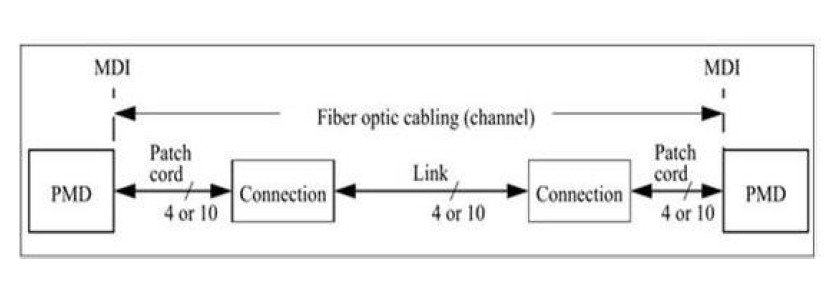
Secondly, the result of network speed and improvement, in terms of fiber optic, core fiber can support the application of 100MB, 1000MB, and 10000MB. More than 200 experts fiberstore working group launched application to support this standard. The following chart we can see a single channel or 4-core 10-core optical fiber, normal 40G and 100G fiber optic network communications are 8-core and 20-core optical fiber. This challenges to traditional dual-core optical fiber transmission, it requires to use a high-density multi core optical fiber. [caption id="attachment_2061" align="alignnone" width="300"]Fiber optic cabling

How do guarantee the performance pre-connected high-density MTP/MPO fiber optic system products in the factory? What is differet from common fiber optic cables?

First the commany must meet the ISO9000 series of quality management system certification, and production process and product performance also meet certification standards of the most comprehensive and the most stringent of fiber optic connector assembly production. Now many factory can produce fiber optic cables.

For another, understand the MPO MTP Fiber system products, whether polarity module or truck fiber cable, whether fiber optic harness or MPO Fiber cable is more complex than SC and LC fiber.

At last, this article discusses the reason of using MPO / MTP high density fiber optic connection system, and give some adive to this new system, fiberstore hope it is helpful to the user of data center and the same occupation.

The Mode of Fiber Optic Cable

Fiber Jumper refers the fiber optic connected directly with a desktop computer or device that facilitate the connection and manage the device. Fiber Optic Cables from the device used to make fiber optic cabling link. There is a thick layer of protetion, generally used in the connection between the optical transceiver and terminal box.

The structure of fiber optic cables:

The fiber optic patch cable is similar to coaxial cable, but no mesh shield. The center is glass core of light travelled. In Multimode fiber calbes, core diameter is 15μm ~ 50μm, as much as a human hair. Single Mode Fiber Cables core diameter is 8μm ~ 10μm. outside the core surrounding the glass envelope which a refractive index lower than the core, in order to keep the fiber optic within the core. And then the outside is a thin plastic that protect the envelope.

The classification of fiber optic cable:

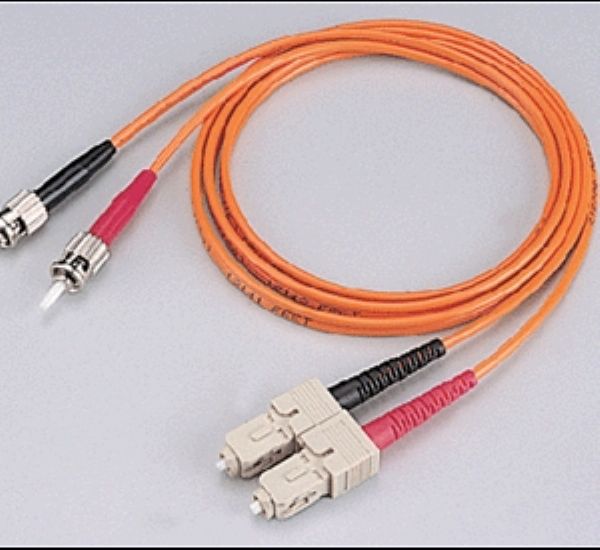
Fiber jumpers in different transmission media can be divided into common silicon single mode and multimode optical fiber, there are others such as Plastic optical fiber as the transmission medium; Fiber jumper can be divided in connector structure: FC fiber cable,sc fiber cable,ST fiber calbe, LC fiber cable and other forms. More common fiber optic cables can be divided into FC-FC, FC-SC, FC-LC, FC-ST, SC-SC, SC-ST, etc.

Single-mode Fiber: generally indicated by the yellow fiber optic patch cords, connetor and protective cover in blue, and transmission distance is longer single mode fiber

Multi-mode Fiber: fiber optic calbes in orange, and some in gray, connetor and protective cover with beige or black, and transmission distance is short. multimode fiber optic

The notes of optic fiber using:

1. Wavelength transceiver modules must be identical at both ends of the fiber jumpers, that must be the same at both ends of the fiber wavelength

optical module, a simple distinction is that the color of the light optic module must be consistent. Under normal circumstances, shortwave

optical module using multimode fiber (orange fiber), long wavelength using single-mode fiber module (yellow fibers) to ensure the accuracy of

data transmission.

2. Do not bend and circling excessively in using the fiber optic, this will increase the light attenuation in the transmission process.

3. After using fiber optic cables, must use protective sleeve protected fiber optic connector, dust and oil will damage the fiber coupling

4. If the fiber optic connectors are dirty, you can use a cotton swab dipped in alcohol to clean, otherwise it will affect the quality of

communication.

The features of fiber optic cables:

1. Low insertion loss
2. Good repeatability
3. Massive return loss
4. Good mutual insert performance
5. Good temperature stability

Application of fiber optic patch cables:

1. Optical fiber communication system
2. Optical Access Network
3. The data transmission of fiber optic
4. Optical fiber CATV
5. Local Area Network (LAN)
6. Test Equipment

Fiberstore.com Guide of Product Selection

Fiber jumpers by Termination are mainly the following three types: ST-ST, SC-SC, ST-SC. By category mainly are fiber single-mode and multimode

fiber. Jumper length specifications 0.5m, 1m, 2m, 3m, 5m, 10m and so on. The cable outer sheath materials can be divided into common type, common

flame retardant, low smoke zero halogen, low smoke zero halogen flame retardant, etc.

2014年5月5日星期一

The actual singlemode as well as multimode dietary fiber introdution

Dietary fiber optic cable television is becoming obvious which Fiber Optic Patch Cords tend to be continuously changing copper mineral cable being an suitable way of conversation transmission tranny. These people period the actual lengthy miles in between nearby telephone techniques in addition to supplying the actual anchor for a lot of system techniques. Additional program customers consist of cable tv providers, college campuses, workplace structures, commercial vegetation, as well as electrical power businesses.

You will find 3 kinds of dietary fiber optic cable television popular: solitary setting,fiber optic multimode cable could be made from clear plastic material, cup, or even a mix of both, the actual materials utilized in long-distance telecoms programs tend to be usually cup, due to the reduce optical attenuation. Each multi-mode as well as single-mode materials are utilized within marketing communications, if you want to transfer much less information more than lengthier miles, make use of solitary setting dietary fiber optic wires. For any higher information capability more than smaller miles, opt for multiple setting dietary fiber optic wires, along with multi-mode dietary fiber utilized mainly with regard to brief miles (as much as 500 michael), Multiple setting is usually employed for LANs along with other little systems. As well as single-mode dietary fiber employed for lengthier range hyperlinks.

Solitary Setting Dietary fiber: Solitary Route with the dietary fiber

Solitary Setting cable television is really a solitary remain (the majority of programs make use of two materials) associated with cup dietary fiber having a size associated with 8. 3 in order to 10 microns which has 1 setting associated with tranny. Solitary Setting Dietary fiber having a fairly thin size, by which just one setting may multiply usually 1310 or even 1550nm. Bears greater bandwidth compared to multimode dietary fiber, however takes a source of light having a thin spectral thickness. Solitary Setting is actually also called single-mode dietary fiber, single-mode optical waveguide, mono-mode optical dietary fiber as well as uni-mode dietary fiber. Single-mode dietary fiber provides you with a greater price associated with tranny, additionally, it may have the actual transmission as much as 50 occasions further range compared to multimode, in a somewhat more expensive. Single-mode dietary fiber includes a a lot scaled-down primary compared to multimode.

Solitary Setting dietary fiber can be used for connecting long-distance changes, main workplaces as well as SLCs (customer cycle service providers, little changes within pedestals within subdivisions or even workplace recreational areas or even within the cellar of the bigger creating). Virtually each and every telco’s system has become dietary fiber optics other than the bond towards the house.

Multiple Setting Dietary fiber: Several Pathways with the dietary fiber

Multi-Mode cable television offers a bit larger size, having a typical diameters within the 50-to-100 micron variety for that gentle have element (in america the most typical dimension is actually sixty two. 5um). Standard multimode dietary fiber primary diameters tend to be 50, sixty two. 5, as well as 100 micrometers. Multiple Setting dietary fiber can be used with regard to smaller miles. The majority of programs by which Multi-mode dietary fiber can be used, two materials are utilized. Multimode dietary fiber provides you with higher bandwidth from higher rates of speed (10 in order to 100MBS – Gigabit in order to 275m in order to 2km) more than moderate miles. Gentle surf tend to be spread in to several pathways, or even settings, because they journey with the cable’s primary usually 850 or even 1300nm. Lengthy cable television operates (Over 3000 ft 914. four yards long), the actual several pathways associated with gentle tend to be thought to trigger transmission distortion in the getting finish, leading to dropped packets as well as imperfect information tranny. IPS suggests using solitary setting dietary fiber in most programs utilizing Gigabit as well as greater bandwidth.