显示标签为“Multimode Fiber”的博文。显示所有博文

2014年6月17日星期二

50/125μm VS 62.5/125μm Multimode Optical Fiber

Multimode fiber is qualified at two primary wavelengths, there are 850nm (short wavelength) and 1300nm (long wavelength). The TIA-568 requirements for minimum bandwidth of 62.5 fiber is 160 MHz/km at 850nm and 500 MHz/km at 1300nm which usually abbreviated as a bandwidth of 160/500 MHz·km. ISO 11801, the international “equivalent” of TIA-568 has minimum bandwidth requirements of 200/500. In both cases, the lower bandwidth of 62.5μm at 850nm is obvious. That lower bandwidth at 850nm becomes problematic when using VCSEL sources.

On the other hand,50μm optical fiber, has a minimum bandwidth requirement of 500/500 MHz/km. It is manufactured to have a peak bandwidth of ~980nm, thus providing good bandwidth at both wavelengths of interest. Because 50/125μm optical fiber has equal bandwidth at both short and long wavelengths, it is capable of supporting technologies bandwidth at both short and long wavelengths, it is capable of supporting technologies equally well at either window of operation.

The IEEE802.3z Gigabit Ethernet committee published two physical layer specifications for fiber, 1000BASE-SX (short wavelength) and 1000BASE-LX (long wavelength). VCSELs are used for 1000BASE-SX transceivers, so the SX electronics will be significantly less expensive than 1000BASE-LX transceivers using a conventional single-mode laser. IEEE 802.3z says that 1000BASE-SX and 1000BASE-LX will operate up to 550 meters on 500/500 MHz·km 50-micron fiber. However, according to IEEE, 1000BASE-SX will operate only up to 220 meters on standard 160/500 MHz·km or up to 275 meters with 200/500 MHz·km fiber. These operating distances are shown in Table 1.

Table 1: IEEE Distance Capability of Gigabit Ethernet over Fiber

Multimode fiber

While these distaces are far longer than those of 1000BASE-T and 1000BASE-TX on UTP cabling, in fact,the 62.5μm fibers do not reach 300m, the distance allowed for multimode fiber in the building riser by TIA-568, becomes problematic for new installations and for existing installations as well.

The distance limitations of 62.5/125μm may prevent an existing network from operating at gigabit per second speeds today, and may pose a greater concern in the event of any facility expansions in the future. 50-micron optical fiber, on contrast, can support over 95% of all the installed fiber network links, while still allowing distance expansions in the future. 50/125 optical fiber will support horizontal cabling (100 meters maximum), centralized cabling (300 meters maximum), and intra-building (inside) backbone cabling (300 meters maximum). The following products shows 62.5/125μm fiber, the products below is Duplex 62.5/125 OM1 Fiber.

 OM1 62.5 Fiber

This is a orange bulk 1000 foot spool of fiber optic cable which intended for large installations where you are completing the terminations. It is a 62.5μm multimode fiber designed to transmit data across shorter distances at LAN speeds. Multimode fiber is optimized to work with fiber optic equipment using light wave lengths of 850nm (nanometers) or 1300nm. The cord is duplex (two fibers) which means it permits synchronous communication between devices. The cladding diameter is 125 microns.

Short-wavelength laser-based technology, the most cost-effective fiber technology today,restricts the application of gigabit speeds on 62.5/125μm to the horizontal space and do not fully support the requirements of centralized and intra-building backbones. On the other hand, 50/125μm can be used for gigabit data rates in horizontal, centralized and intrabuilding backbone segments. The following products shows 50/125μm fiber, the products below is Duplex OM2 50/125 Multimode LC-SC Fiber.

It is specifically designed for use with today's narrower aperture components, this cable is fully compatible with multimode applications. The patented injection molding process provides each connection greater durability in resisting pulls, strains and impacts from cabling installs.

Additionally, 50/125μm infrastructure also works with the same LED-based LAN electronics that are installed and still being supplied. Today’s optical fiber hubs, switches, NIC cards and media converters are multi-mode products not specifically designed to operate with one fiber type or the other. The same connectors are utilized for 62.5/125μm and 50/125μm fiber networks. So, 50-micron optical fiber works well with today’s readily-available LED-based components while providing a seamless migration into laser-based technology, thus making it the best choice. Figure 1 shows the recommended application space for each fiber type.

Figure 1: Fiber Types, Data Rates and Distances
 fiber

2014年6月10日星期二

The Progress of Multimod Fiber

In 1976, Corning developed 50/125μm by the graded-index multimode fiber and 1983 by Lucent Bell Labs developed 62.5/125μm graded-index multimode fiber, they are two larger amount of Multimode Fiber. The cladding diameter and mechanical properties of these two fibers are same, but different transmission characteristics. They can provide such as Ethernet, Token Ring and FDDI protocols specified in the standard distance required bandwidth, and it can be upgraded to Gb/s rate.

The new multimode fiber standard grades issued by ISO / IEC 11801, Multimode fiber is divided into four categories, OM1, OM2, OM3, OM4. OM1 and OM2 refer to traditional 62.5/125μm and 50/125μm multimode fiber. OM3 and OM4 refer to the new Gigabit 50/125μm multimode fiber.

62.5/125μm Graded-index Multimode fiber(OM1,OM2)

Common 62.5/125μm graded-index multimode fiber is the IEC-60793-2 fiber optic products specification Alb type. As the core diameter and a numerical aperture of 62.5/125μm fiber is greater, which has a strong anti-concentrating ability and bending characteristics, especially in the 20th century, before the mid-1990s, the lower the rate of the LAN, less demanding on the fiber bandwidth, thus making this fiber to obtain the most widely used, becomes 20 years between the mid-1980s to the mid-1990s mainstream products in most countries data communications fiber market. Belong OM1 and OM2 fiber types of Alb full power injection (OFL) bandwidth respectively 200/500MHz.km (850/1300nm) 500/500MHz.km (850/1300nm).

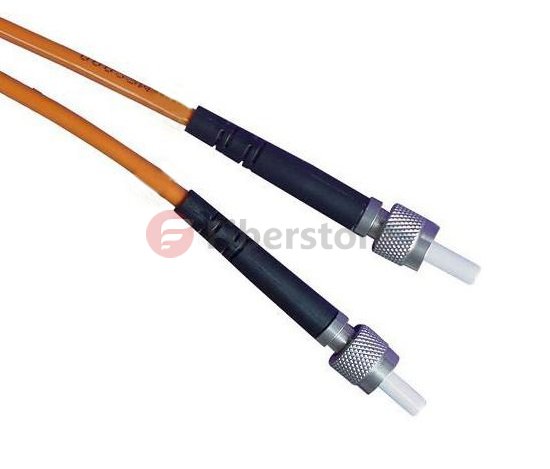
Now you can see the follow products about 62.5 Multimode Fiber

  Duplex OM1 62.5/125 Dia2.5mm Fiber Patch Cable

SMA905- SMA905 Duplex OM1 62.5/125 Dia2.5mm Fiber Patch Cable from Fiberstore

50/125μm graded-index multimode fiber(OM1,OM2)

Common 50/125μm OM2 Fiber graded-index multimode fiber is the IEC-60793-2 fiber optic products specification Ala.1 type. Historically, in order to reduce as much as possible the cost of the LAN system, widely used inexpensive LED as the light source, rather than expensive LD. Since the LED output power is low, the divergence angle is much larger than LD, while the core diameter and a numerical aperture of 50/125μm multimode fiber are relatively small, is not conducive to efficient coupling with the LED, as large core diameter and numerical aperture of 62.5/125μm (Alb class) fiber enables more light power coupled into the fiber link to, therefore, 50/125μm graded-index multimode fiber in the mid-90s as good as 62.5/125μm (Alb class) that is widely used fiber.

Since the 20th century, a local area network developed up to lGb / s rate, it didn't meet the requirement 62.5/125μm OM1 Fiber bandwidth with LED light source. Compared with 62.5/125μm multimode fiber, 50/125μm multimode fiber core diameter and a numerical aperture smaller, 50/125μm gradient in the number of multi-mode fiber conduction mode refractive index of about 62.5/125μm multimode fiber conduction mode 1/2.5, thus effectively reducing the modal dispersion of a multimode optical fiber, such that the bandwidth is significantly increased production costs .50/125μm multimode optical fiber is reduced to about 1/3. So make it again been widely used. IEEE802.3z Gigabit Ethernet standard provides 50/125μm multimode and 62.5/125μm multimode fiber can be used as a transmission medium using Gigabit Ethernet. But for the new network is generally preferred 50/125μm multimode fiber. Belong OM1 and OM2 fiber types are Ala. 1 full power injection (OFL) bandwidth respectively 200/500MHz.km (850/1300nm) and 500/500MHz.km (850/1300nm).

OM3 Optical Fiber

Traditional OM1 and OM2 multimode fiber from the standard mode and design are based LED, as the operating wavelength of 850 nm, a low price VCSEL (Vertical Cavity Surface Emitting Laser) and the emergence of wide application, 850nm importance window increased. VCSEL can be lower than the price of long-wavelength lasers to improve network speed to the user. 50/125μm multimode fiber has a higher bandwidth 850nm window, low price VCSEL can support longer transmission distances for Gigabit Ethernet protocol, and the high rate support longer distances. With the improvement of network speed and size, modulation rates up to 10Gb/s short-wavelength VCSEL laser light sources become one of the high-speed network. Since the difference between the two light-emitting devices, optical fibers must transform itself to adapt to changes in light. In order to meet the needs of 10 Gb / s transfer rate, the International Organization for Standardization / International Electrotechnical Commission (ISO/IEC) and the Telecommunications Industry Alliance (TIA) joint drafting of a new generation of 50 μm core multimode fiber standard. ISO/IEC in the new multi-mode fiber grade they will develop a new generation of multi-mode fiber is zoned 0M3 category (IEC standard A1a.2).

OM4 Optical Fiber

OM4 optical fiber is optimized for the 50μm core multimode fiber, currently, the OM4 (IEC standard A1a.3) criteria is actually an upgraded version of an OM3 multimode fiber. Compared with standard OM3 OM4 fiber, fiber bandwidth indicators just do upgrade. That OM4 standards are made ​​to improve the 850nm wavelength effective modal bandwidth (EMB) and the full bandwidth of the injection (OFL) compared to OM3 fiber.