2014年5月29日星期四

One of Most Major applications of Optic Fiber—FFTH

FTTH (Fiber To The Home), it is Fiber Optic Patch Cables directly to the home. Specifically, FTTH optical network means (ONU) installed in the home or business user of the user, the optical access network is a series of optical access the user application type except FTTD (fiber to the desktop) closest outside. FTTH technology is characterized by significant not only provides greater bandwidth, but also enhanced network data format, speed, wavelength and protocol transparency, relaxed on the environmental conditions and power requirements, simplifies maintenance and installation.

FTTH advantage

1.FTTH is a passive network, from the central office to the user, fiber optic coupler, fiber optic passive components accounted for most of the equipment, it can be done in the middle basically passive
2.It is relatively wide bandwidth. Large-scale use is in line with the way long distance carriers.
3.It is a direct bearing on the fiber business, so there is nothing complex issues.
4.Because of its relatively wide bandwidth, support for the agreement is more flexible.
5.With the development of technology, including point to point, 1.25G and FTTH way have developed a relatively complete function.

The optical fiber directly to the user's home, its bandwidth, wavelength and transmission technology types are no restrictions for the introduction of new services, it is the ideal business transparent network, and it is aslo the ultimate way to access network development. Although the development of mobile communications at an alarming rate, but because of limited bandwidth, terminal volume can not be too large, the display screen is limited and other factors, it is still pursuing a fixed terminal performance, which is hoped to achieve FTTH. Fiber to the home's charm lies in its great bandwidth, it is the best solution to solve from the Internet backbone to the user's desktop bottlenecks.

The related products about optical fiber, FC/UPC to FC/UPC 4 Fibers SM 9/125 Single mode Fiber Patch Cable
  Single Mode Fiber Patch Cable  
FC-FC 6 Fibers OM1 62.5/125 Multimode Fiber Patch Cable Multimode Fiber Patch Cable
 With the upgrading of technology, greatly reduces the cost of fiber to the home, it will soon be reduced considerably with DSL and HFC networks, which makes it possible for practical FTTH. In China, FTTH is also imperative. From 2011, in China from coastal cities to inland cities, from east to west, opened the curtain FTTH construction. You can say that FTTH is a highlight of optical fiber communication. Accompanied by a corresponding technologies mature and practical, cost closer to ordinary families can afford to reduce the level of FTTH trend is unstoppable.

Furthermore, FTTH technology is still used to solve the "last mile" problem of the information superhighway. FTTH + Ethernet over ADSL (ADSL dial-up time will be established at the highest theoretical 8Mbps download bandwidth, this bandwidth is never changed, but in fact, because the noise detection mechanism ADSL line situation is not good, if it is clearly beginning to establish a connection not reach the theoretical value, may finally be 5Mbps, this bandwidth is also not change.) and ISDN (European popular form of telephone network) transmission speed is much faster.

FTTH has been considered a rising star ultimate ideal access networks, but also broadband development. Because it can meet the diverse needs of various users. Like high-speed communications, home shopping, high-definition television, video on demand and more. The copper wire is the reluctance of the business, it is easy for FTTH. One can imagine, FTTH is to realize telephone, cable TV and Internet "triple play" the best choice.

2014年5月27日星期二

10G Ethernet Transmission MPO System Scheme

June 2002, IEEE802.3ae Task Force issued a series of fiber-based Gigabit Ethernet standard, commonly used in LAN 10GBase-SR/SW as example, 10GBase-SR/SW using serial transmission technology, that is, each core optical fiber only send or receive signals, so to achieve 10Gbps transmission requires at least two-core optical fiber.

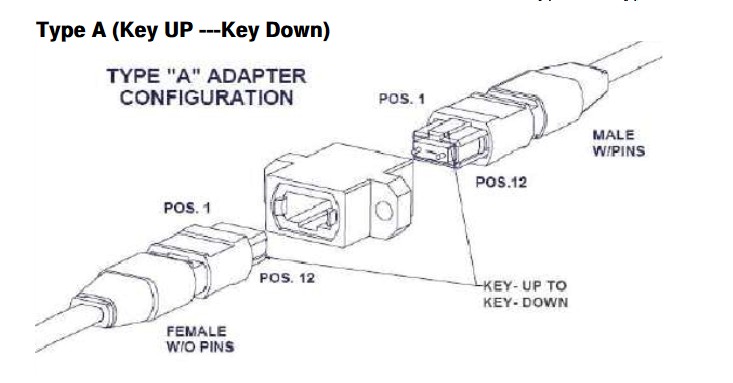
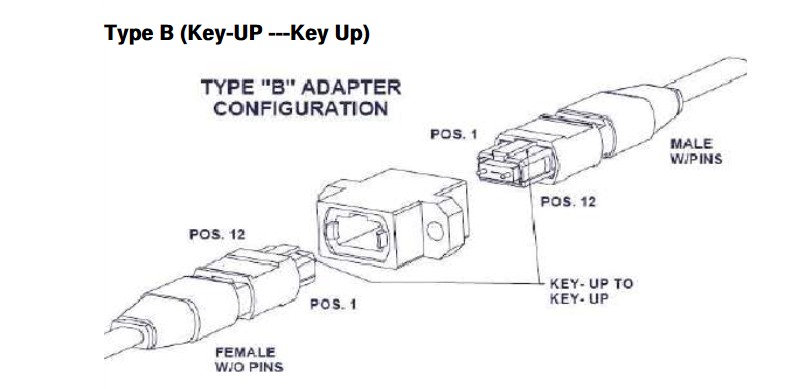
MPO fiber optic deployment system has two solutions, one is to use the program with MPO module box, because MPO module box is with metal needles, therefore MPO trunk cables do not need to distinguish whether with a metal pin (Pin), most users tend to use MPO module case scenario; another option is to use MPO coupler, such programs must differentiate between MPO trunk cables with metal needles and without metal pin, the other two ends need to convert Fiber Jumper, so this program is rarely adoption.

According ANSI/TIA-568-C.3 standards are divided into the following two types of duplex Fiber jumpers:

Standard: (A-B) MPO Fiber Non-Standard: (A-A) MPO According ANSI/TIA-568-C.3 standard, MPO coupler is divided into Type A, Type B two types: MPO Fiber Connector   MPO Fiber Optic MPO fiber optic system according to the MPO trunk cables, MPO module boxes and jumpers of different types have different combinations of programs, mainly A, B, C three kinds of channel combination scheme

Method A: Using straight-through (Type A) of MPO trunk cables, Fiber Jumpers must be used at both ends of different models, Scenario A increases the complexity of the orders, it is not recommended to use programs A.

Method B: A fully cross (Type B) of MPO trunk cables, MPO module box must use two different types (Key Up-Key Up) and (Key Down-Key Down), another plan B does not support the ramp octave end face (singlemode fiber, so most manufacturers do not recommend using program B.

Method C: Using lines cross (Type C) of MPO trunk cables, MPO consistent at both ends of the module box (Type A) and standard jumpers, so Option C is the solution of choice for 10G Ethernet recommended.

There are some related MPO products from fiberstore, you can see to know more about MPO Fiber.

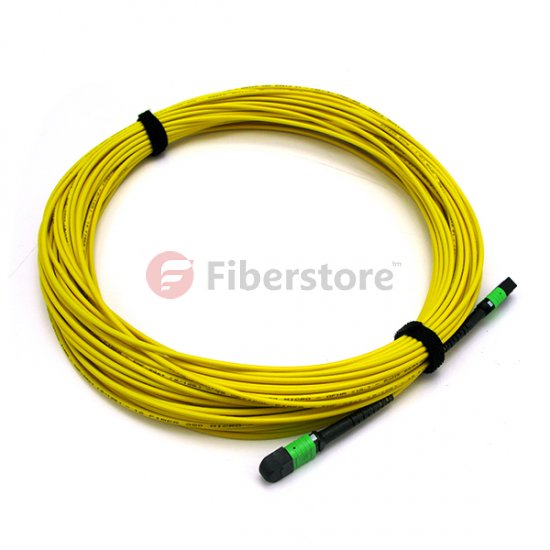
12 Fibers, Single-Mode, 12 Standard MPO Fiber Cable,3.0mm LSZH MPO Trunk Cable

FiberStore offer singlemode and multimode (OM1, OM2, 10G OM3, 10G OM4) MPO/MTP Cable. Singlemode MPO MTP Fiber cable is primarily used for applications involving extensive distances, 10G Mpo Cassettes provide 10 gigabit data transfer speeds in high bandwidth applications and they are 5 times faster than standard 50um fiber cable. Work with both VCSEL laser and LED sources. The meanwhile, we also provide 40G/100G MPO/MTP trunk cable.

2014年5月26日星期一

The Advantages And Disadvantages of Multimode And Single-mode Fiber

1. The Development of Optical Fiber

1.1 Development of Single-mode Fiber

The late 1970s, people tried to use the successful development of long-life semiconductor laser light source to replace the light tube, in order to get longer communication distance and greater communication capacity. However, the laser pattern noise occurs in the multi-mode transmission fiber. To overcome pattern noise, in 1980 successfully developed the zero dispersion point at 1.31m single-mode fiber (non-dispersion shifted single-mode fiber). The International Telecommunication Union (ITU-T) recommended that such a single-mode fiber is defined as G.652 fiber. Because the design of a single mode fiber is only thinking of a transmission mode, so the pattern noise in the transmission multimode fiber occurred does not occur. Thus, the mid-1980s, by the laser light source and composition of the 140sMbit G.652 Fiber Optic Patch Cables communication systems [2], which, following distance and transmission capacity far exceeds the coaxial cable so that the optical fiber communication gradually replace the use of copper to become the the main means of communication in telecommunications industry.

1.2 Development of Multi-mode Fiber

Thinking of optical fiber communication by Chinese-American Kao paper published in 1966 , " optical frequency dielectric fiber surface waveguides " made of quartz glass optical signal transmission fiber ( referred to as optical fiber ) to communicate. In 1970, the British telecommunications, Bell Labs and Corning Glass Company jointly developed the world's first root attenuation coefficient 20kmdB Multimode Fiber Cables[ 3 ]. It should be noted that the multi -mode fiber as the optical transmission medium of the semiconductor laser and a long life as a prelude optical fiber common carrier communication research. Expand and increase the transmission speed of the optical fiber communication transmission capacity, transmission distance is extended and the fiber attenuation is closely related to dispersion and nonlinear effects. Innovation process is that the people of fiber varieties of fiber attenuation, chromatic dispersion , nonlinear effects in optical fiber communication systems and other performance plays an important role in the recognition process. 1976 Bell Labs in the United States between Atlanta to Washington establish the world's first practical optical fiber communication systems,the transmission speed of 45sMbit, uses a multi-mode fiber . Multimode fiber always is trying to reduce the attenuation and mode dispersion, and further improve the transmission bandwidth of optical fiber as the research center. In recent years, studies have multimode fiber mutagenicity progress, fiber transmission bandwidth has been greatly improved.

2. Principle of Multimode Fiber and Single-mode Communication

Optical fiber communication is the use of light as a carrier to transmit information, and optical fiber as a transmission medium to achieve information transmission, one of the latest communications technology achieve the purpose of communication. Therefore, the principle of the optical fiber and the transmission of information studies is important.

First, optical fibers transmit information use the principle of total reflection of light, i.e., when the light from the optical dense medium (higher refractive index medium) optically thinner medium intake, the refraction angle will be greater than the incident angle, when the incident angle to a certain degree, the angle of refraction of the incident angle of 90 °of this case referred to the total reflection angle. When the angle of incidence continues to increase, will not happen this time refraction, reflection and safety of all incident light is reflected Theorem. This phenomenon is a reflection. To achieve total internal reflection optical fiber to satisfy two conditions: Light must be incident light from the optically denser medium to dense medium; Angle of incidence must be greater than the critical angle. Thus, a practical optical fiber essentially consists of three parts, namely, a high refractive index of the core portion and the refractive index of the lower cladding layer and the outer coating layer.

There are many classification of Fiber Optic Patch Cables, but there is a very important classification, according to the number of conduction-mode fiber to classify, so-called "model" refers to a certain angular velocity of a beam of light into the fiber. Only one mode of conducting could be single-mode fiber, the fiber can be transmitted to a plurality of mold for hundreds of patterns is called a multi-mode fiber. It is possible to determine the number of transmission modes, an important structural parameter is the normalized frequency of the fiber, generally denoted by V, defined as:

Fiber optic calbe

2.1 Multi-mode Optical FiberThe number of fiber conduction mode with its normalized frequency, the total number of conduction mode similar to:

Multimode Optical Fiber

Wherein, V is the normalized frequency of the fiber, αis the fiber refractive index profile exponential. For example, the total number of parabolic fiber α=2, the conduction mode is:

Fiber optic cables


2.2 Single-mode Optical FiberOnly one mode fiber transmission is called multimode fiber, Single Mode Fiber Cable can transmit the fundamental mode (lowest-order mode), there is no difference between the mode delay. Therefore, single-mode fiber refractive index α profile exponential impact on its far less bandwidth multimode fiber is generally used large step-index profile.

Singlemode Fiber optic cables

2014年5月25日星期日

Key Technologies And Development of Multi-mode Optical Fiber

Corning and Lucent and other large companies proposed a "new generation of multi-mode fiber" concept to the international standardization bodies. A new generation of Multimode Fiber Patch Cable; standards drafted by the International Organization for Standardization / International Electrotechnical Commission (ISO / IEC) and the Telecommunications Industry Alliance (TIA-TR42). As a new generation of multi-mode fiber transmission medium 10Gb / s Ethernet, be included in IEEE 10Git / s Ethernet standard. This article will briefly describe the new generation of multi-mode fiber critical technical information.

1.1

The Typle of New Generation of Multimode fiber

The new generation of Multimode Fiber Cable is 50/125μm, graded-index multimode fiber distribution. The number of this transmission mode Fiber Optic Cables is approximately 62.5μm multimode fiber transmission mode 1/2.5. This can effectively reduce the dispersion of the multimode fiber mode, increase the bandwidth. For 850nm wavelength, 50/125μm Multimode fiber bandwidth is 500MHz.km. Recent experiments confirmed: the use of 850nm vertical cavity surface emitting laser (VCSEL) as a light source in the 1Gb / s rate, 50μm multimode fiber core diameter standard error can be no transfer 1750m, 50μm core diameter multimode fiber can be a new generation of error-free transmission 2000m. In the 10Gb / s down, 50μm core diameter multimode fiber can transmit a new generation of 600m. A new generation of multi-mode fiber is mainly used to support high-speed Ethernet (Ethernet), Fibre Channel (FC) and fiber optic interconnection (OIF). Meanwhile at 10Gbit / s system can transmit 600m, so that it can be used for building backbone and campus backbone extraordinary distance from the middle. In the data center design, within a distance of 100m to support higher speed (40G and 100Gbits / s? Ethernet, 16G and 32Gbits / s Fibre Channel) data transmission requirements.

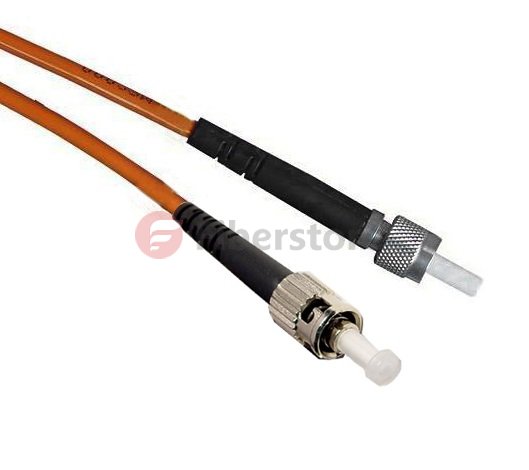
The related products about New Generation Multimode fiber, SMA905-ST Duplex 50/125 Dia2.5mm OM2 Multimode Fiber Patch Cable from fiberstore.com, the products picture is below:

OM2 Multimode Fiber
The SMA-905 fiber optic patch cord, also known as FSMA connector, was one of the First fiber optic interconnect system that gained industry wide acceptance.SMA905 fiber patch cords make use of threaded connections and is still widely used for military, industrial, medical and Surgical applications and laser systems because of their low cost multimode coupling. It features simple termination and Assembly, and is TIA and IEC compliant. SMA 905 multimode connectors are available with stainless alloy or stainless steel ferrules.

1.2 A New Generation of Multi-mode Fiber Source

Traditional multimode fiber networks use light-emitting diode (LED) as light source . In low-speed network, which is an economically rational choice. However, LED is spontaneous emission light, the radiation -emitting laser is excited , the carrier lifetime is longer the former than the latter, and thus the LED modulation rate is limited , and not more than gigabit networks. Further, LED compared with a laser, the beam divergence angle, wide spectral width . After injection of multimode fiber , excite more high-order mode, the introduction of more wavelength components, so that the fiber bandwidth decreases . Fortunately 850nm vertical cavity surface emitting laser (VCSEL) not only has the advantage of these lasers, but aslo the price is basically the same with the LED. Other advantages of VCSEL are: low threshold current, may not be enlarged, driven directly by logic gates at 10Gb / s rate, get a few milliwatts of output power; emission wavelength of 850nm which does not apply to the standard single-mode fiber just for multimode fiber . At this wavelength, an inexpensive silicon detectors can be used and have a good frequency response; VCSEL another remarkable advantage is that the manufacturing process can be easily controlled distribution of the emitted light power , which is very advantageous for improving the bandwidth of MMF. It is because of these advantages, the new generation of multimode fiber standard will use 850nm VCSEL light source.

1.3

The Bandwidth Distance of New Generation Multimode Optical Fiber
By comparing the above- described laser and LED , the use of multimode fiber laser light source, the transmission bandwidth should be greatly improved. However, experimental results show that simply make the bandwidth of a laser instead of LED light source, system is not only reduced but increased. IEEE Expert Group found through research, the bandwidth of multimode fiber and the optical fiber or the injection molding state of a power distribution. The preform fabrication process, the refractive index of the fiber axis prone to depression. Done before light source LED, is overfilled launch (OFL-Over Filled Launch), all of the fiber mode ( hundreds ) are excited to bring their own part of each module power. The refractive index of the fiber center delay characteristic distortion affects only a small number of models, the relatively limited impact on the modal bandwidth of the fiber. The measured multimode fiber bandwidth for the use of LED light source system is correct. However, when a laser light source, a laser beam spot is only a few microns, the divergence angle is smaller than the LED, so that only a small number of modes excited in the center of the fiber transmission, each mode carries a large part of the power, the refractive index of the fiber center distortion affect a small number of patterns of delay characteristics, so that decreased multimode fiber bandwidth. So it can not be measured with a laser light source for multimode fiber OFL bandwidth of conventional methods.
Today a new generation of multi-mode fiber main measurement bandwidth limit die by injection method (RML-Restricted Mode Launch). In this way the measured bandwidth is called " laser -bandwidth " or " modal bandwidth limit ", previously done with the LED light source measured bandwidth is called "OFL bandwidth is ." Both represent the bandwidth of multimode fiber laser and LED light source with a time of injection. August 5, 2009, TIA Standards Committee released a new generation of bandwidth distance product standard multimode fiber , 850nm laser distance -bandwidth product of 470MHz.km, 850nm OFL bandwidth of distance product of 350MHz.km, 1300nm OFL bandwidth of distance plot to 500MHz.km. Incidentally, the bandwidth from the product of the above-described generation of the multi-mode fiber is only 3dB corresponding baseband bandwidth of multimode fiber, multimode fiber does not take more than a high-frequency band -pass region is also used when the transmission signal . Today, by orthogonal frequency division multiplexing (OFDM) technology , can make good use of multimode optical fiber through a high frequency band region , under conditions of use of the same Fiber Optic Patch Cables type, transmission using high frequency band signal through region greatly improved multi-mode fiber transmission capacity.

1.4 Source Injection Method

In actual use, the multimode fiber coupled laser and the following methods:
Bias injection: In order to avoid the deterioration of these lasers is injected directly into the bandwidth MMF appears, use the mode regulator
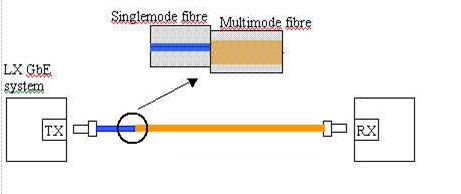
Connection (MCP Mode Conditioning Patch Cable), the laser output is coupled into a multimode fiber. Connection-mode regulator is a short Single Mode Fiber Cable, one end of which is coupled with the laser and the other end coupled to a multimode optical fiber. SMF output spot detouring from the multimode fiber axis at a distance, allowing the deviation from the range is 17 ~ 24μm, the aim is to avoid the center of the refractive index depression, but do not deviate too far, only one group is selectively lower-order mode excitation .

Centre injection: ideal for the refractive index profile, there is no central depression MMF can be used instead of the center of the injection molding
Regulator connection. The advantage of this is that the bandwidth of the laser can effectively improve the MMF to reduce the complexity of the network system and reduce system cost, a current-mode regulator 80 to the connection of approximately U.S. $ 100. Corning launched InfiniCor CL 1000 (62.5μm core diameter) and InfiniCor CL 2000 (50μm core diameter) is Gigabit Ethernet 1300nm wavelength laser directly into the mode without adjusting the first multi-connection mode fiber.

2014年5月22日星期四

The Technical Characteristics And Application Prospect Of New Generation Multimode Fiber

As we all know , due to the use of the Internet, the data transmission requirements show explosive growth like a geometric progression, so the network transmission speed requirements are also increasing intensity. The multi mode fiber is concerned , due to its inherent properties , it is generally used in a LAN , storage network , data center. In these areas , the data transmission rate of exchange is also required to continue to grow . To Ethernet , for example, since the 1990s , the transmission rate from 10Mbit / s ( Ethernet ) to 100Mbit / s ( Fast Ethernet ). IEEE in 1998 by the IEEE802.3z of Gigabits Ethernet (GbE) standard . 10Gigabit Ethernet standard IEEE802.3ae also passed in June 2002 . Multimode fiber products have been defined by the standard Ethernet transmission medium, its transmission window is at 850nm and 1300nm. Current land use in a communications network products for the general multimode A1a (50/125um) and A1b (62.5/125um) two kinds. Both products are performance and calibration of Ethernet and Fast Ethernet compatible. Just GbE Ethernet and 10GbE Ethernet standard is concerned , A1a and A1b multimode product is not suitable. Mainly due to the modulation frequency of LED (light emitting diode ) light source, only a maximum of about 650MHz. So Gbit / s and 10Gbit / s Ethernet must use LD ( laser diode ) as a light source, such as VCSEL ( vertical cavity surface emitting laser ) light source . This change makes the light A1a and A1b multimode fiber show a mode dispersion problem, the transmission distance can not meet demand. Therefore, it needs to improve the multimode fiber manufacturing technology , development and manufacturing of new generation of multi -mode fiber . This article describes a new generation of technical characteristics and application prospects multimode fiber.

Generally, there are many index to impact multimode fiber performance, but the direct result to the transmission distance is mainly affected by attenuation and multimode fiber bandwidth parameters. The attenuation parameter is determined by the fiber structure and the dopant concentration, the new generation of Multimode Fiber Patch Cable is same with the original fiber optic calbe on the product structure. so they are the same attenuation indicators . Multimode fiber bandwidth uses MHz.km units. It is the modulation frequency and the length of the fiber product of the maximum modulation frequency of the pulse period of the optical fiber which can pass through. Because bandwidth is a comprehensive index multimode fiber characterization of the optical properties, it is affected by many factors, such as the light source, coupling waveguide structure, as well as the receiver performance aside other factors, on the fiber itself, determine its bandwidth intrinsic factor is a multimode fiber dispersion properties. Discussing multimode fiber dispersion analysis generally two ways, i.e., inter- mode dispersion and chromatic dispersion. That is, since the chromatic dispersion of the transmission of different wavelengths of light caused. Mode dispersion refers chromatic dispersion due to the different transmission modes caused. The essential difference between the ordinary and the new generation of multi -mode optical fiber is a multimode optical fiber being derived from this.

Optical Fiber
 Figure 2
 Multimode fiber

For Common multimode fiber, since the LED light source are intended to be used in a network system. LED light source is a wide spectrum of areas having a large output. Due to its broad spectrum of characteristics, emitted light have different wavelength components, when such a light pulse is transmitted in the optical fiber, dispersion is the main cause of chromatic dispersion. The new generation of multi-mode fiber optic network is expected to be used in the LD light source. LD is a single-wavelength laser light source, the LD so emitted light pulse transmitted in the multi-mode fiber, dispersion-mode dispersion will be the main cause.

The related proucts about Common Multi-mode Fiber Optic Cable from Fiberstore, SC-SC Simplex 62.5/125 OM1 Multimode Fiber Optic Cable,

OM1 SC SC Multimode Fiber Patch Calbe

At the same time, because the common manufacturing process multimode fiber defects appear in the center of the center "recess", this defect is due to the dopant material, such as a transition caused by evaporation of germanium. While multimode fiber interface, i.e., between the fiber core and cladding is easy due to the diffusion of dopant materials such defects. These defects in the original multi-mode fiber is not important. But for a new generation of multi-mode fiber is fatal. These defects will greatly increase the inter-mode dispersion and reduce the transmission properties of the optical fiber.

For the light source, the table 1 is a comparison of a typical LED light source and a VCSEL. it can be found, VCSEL is much less than the spectral width of the spectral width of the LED, so the purpose of comparison to the LED, LD can be said that the injection of a single wavelength. The LED and light emitted from the LD of different spot size. LED exit a larger area, you can inspire all of multimode fiber conduction mode, while LD light spot emitted only a small part inspired conduction mode. When injected into the LD multi-mode fiber end faces at different locations, different mode groups are excited, it will make the inter-mode dispersion and a greater difference between the transmission distance of the impact pulse. Figure 4 shows a comparison of light output LED and a VCSEL.

Injection method means the energy emitted by the light source is coupled into the multimode fiber process. Generally limited to full injection and injection molded in two ways. When the LED light source is a full injection, i.e., spot size, and light emitted from the multimode fiber core sizes are matched, then the pulse is excited in the multimode fiber optic cable conduction mode transmission, the transmission energy is concentrated in the middle mode group. While limiting the injection mold, the incident light spot covers only a part of the core, when it is conducting, it is only part of the excitation conduction mode groups. When the incident light spot at different positions of the core, the excited mode groups are different, resulting in differences in the inter-modal dispersion such that the bandwidth performance of the change of the transmission fiber. Therefore, when injected into the mold limit, you must determine the position and angle of the incident, otherwise the transmission distance of fiber support will change.

In IEEE802.3z GbE Ethernet standard, for the laying of fiber optic cable has proposed a so-called Patch cord [4] solution is injected into the mold of a typical limit program. In the 1300nm wavelength, this solution uses a single mode fiber as shown bias limit injection molding conditions, this Single Mode Fiber Cable can not only reduce multi-mode fiber optic which conduction mode is excited, but also partial connection set. It can avoid larger centers may exist in the optical fiber embedded in a recess problems.


 Multimode Fiber Calbe

The above shows that the use of ordinary multimode fiber at Gbit / s and 1010Gbit / s Ethernet system, the light source, injection method and fiber itself, it will greatly deteriorate the performance of optical fiber transmission, increase system overhead, or increase system complexity. To solve these problems, the development of a new generation of suitable Gbit / s transmission rate over multimode fiber using a local area network products are the best choice. The new generation multimode fiber products from Fiberstore, you can find the related products, MPO MTP Fiber. MPO/MTP Fiber Cable is offered for many applications for all networking and device needs like 100 Gig modules. MPO Fiber Cable From Fiberstore are available in UPC and APC finishes, it supports both multimode and single mode applications, and optional lengths available. Our MPO/MTP fiber cable is with push connector IEC 61754-7 and TIA/EIA 604-5A compliant and offer low cost per termination for high density applications.

2014年5月21日星期三

What Is Singlemode and Multimode Optical Fiber?

Light is an electromagnetic wave (visible light frequencies in the order of 10 ^ 14), singlemode fiber and multi-mode fiber optics are needed to explain fluctuations. The basic formula is the electromagnetic theory of Maxwell's equations, the boundary conditions of Fiber Optic Cables (size, refractive index, wavelength and other parameters) into Maxwell's equations.

multimode fiber optic

The solution obtained contains numerous real and imaginary part, representing the spatial distribution of the electromagnetic field and the transmission, each solution can be called a mode, the real part can be interpreted as conductive portion for satisfied the total reflection conditions, it can be called the conduction mode. the imaginary part is rapid loss in the transmission swap, known as radiation modes. The solution with the fiber size, fiber core and cladding refractive index, the wavelength dependence of the incident light. When the fiber core size decreases, the mold can be found rapidly reduced conduction, in particular core size and wavelength may be compared, the conductivity is reduced to the mode field distribution is also a space appears discontinuous, showing the geometrical optics can not be explained. "quantum properties. "When reducing the fiber core size to a certain number, the only one possible conduction mode, this time, the optical fiber for this incident became a single-mode fiber.

Single Mode Fiber
 
Single Mode Fiber Patch Cable is relative, when the wavelength of the incident light is reduced, there will be a new conduction mode, this is relatively light, Fiber has become multimode fiber. So there is a cutoff wavelength of a single-mode fiber that is higher than this wavelength, which is the single-mode fiber. G 652 common singlemode fiber cutoff wavelength less than 1260nm.

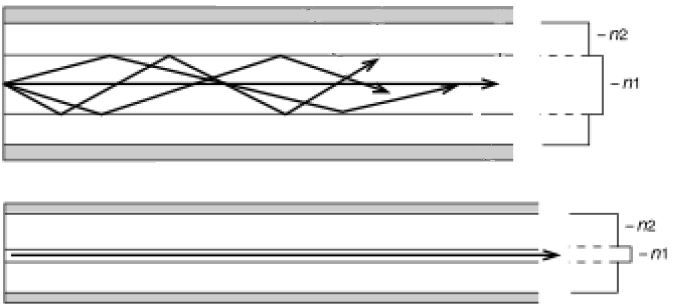
Multimode Fiber Optic Cable can be understood as approximately the incident light along many different paths in the optical fiber transmission angles. Clearly different from the other end along the length of the different paths, because the length of the transmission time difference generated by different known mode dispersion (i.e. different paths in different modes).

Single mode optical fiber can transmit along a path (ie, only one mode), there is no mode dispersion. But with different refractive indices in different wavelengths of light in the same material, resulting in different transmission rate, so if the same beam of light contains different frequencies, the other end to the optical fiber transmission time is different, this causes the transmission time difference is called Single-mode dispersion or material dispersion or wavelength dispersive. Not the kind of light source is entirely monochromatic, the wavelength dispersion is widespread. We usually use several sources of communication, the wavelength dispersion smaller than the mode dispersion.

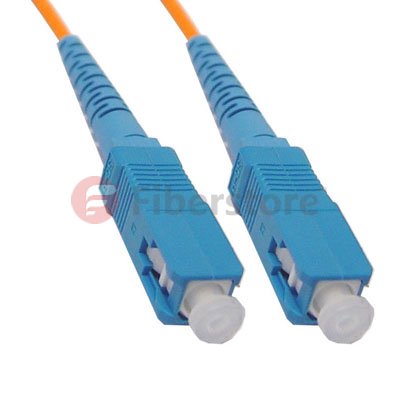
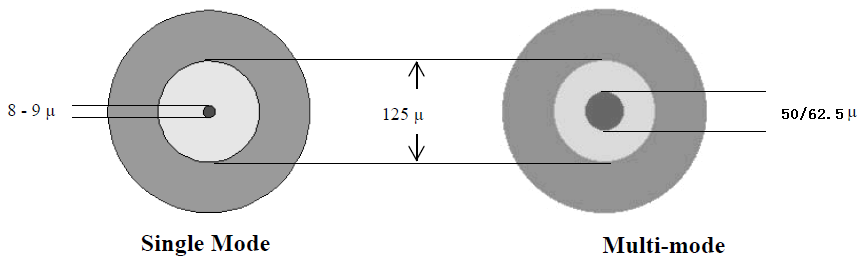
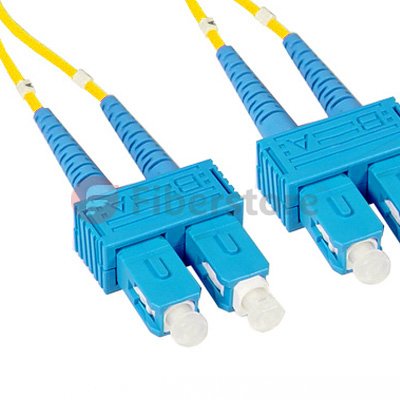
Common single-mode fiber (G 652) is about 8-10um core diameter, the related proudcts from Fiberstore, it's Duplex 9/125 sc to sc fiber patch cord. The picture is follow:

 sc-sc singlemode fiber optic cable

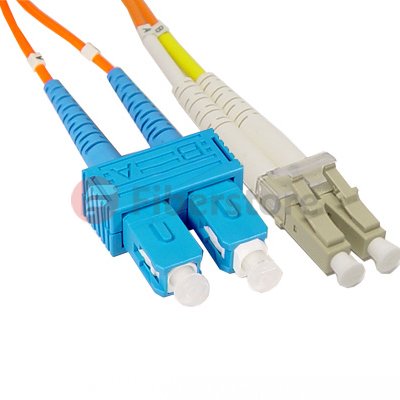
Sc to Sc Fiber Patch Cord is for high bandwidth and transmission rates over longer distances. This SC fiber patch cable is specifically designed for gigabit ethernet applications. The patented injection molding process provides each connection greater durability in resisting pulls, strains and impacts from cabling installs. Common multimode fiber core diameter, there are two types, 50um and 62.5um. The related products from Fiberstore, it's Duplex OM1 Multimode 62.5/125 Lc-Sc Fiber Patch Cable. The picture is follow:

sc to lc multimode fiber patch cable
Article Source From:http://www.cables-solutions.com

2014年5月20日星期二

Dispersion And Types of Multimode Fiber

Multimode optical fiber dispersion is the time of the different modes in a multimode optical fiber transmission difference generated, because there are many mode of multimode fiber, the resulting dispersion is more complicated. So multi-mode optical fiber is not used as a dispersion single-mode fiber to characterize the dispersion properties of the coefficient. Multimode Fiber Cables with dispersion characteristic pattern "Bandwidth " to indicate that the " bandwidth" of the multi-mode fiber, it means the ability of a transmission signal in units of MHz * Km, refers to the product of speed and distance , low rate the transmission distance and high- speed transmission distance is near . With a "Bandwidth " associated with the type of light source used for multimode fiber. Different types of light sources with the same optical fibers obtained by the test "Bandwidth " is different, the bandwidth of a multimode optical fiber with the general terms of use. Different types of light emission characteristics of the injection for reasons multimode fiber mode excitation type : LED can excite all modes, this light is called test OFL (overfilled launch) testing. FP and VCSEL lasers with multi-mode fiber can stimulate injection -mode optical fiber portion , such tests are called UFL (underfilled launch) Test This test out several light sources "bandwidth " is different .

Species historically commercialization of multimode fiber is very large, there are different classification methods, the current standard is more popular in the beginning of 2002 classification ISO / IEC 11801 enacted.

ISO / IEC standard classification simplifies multi-mode fiber. The old 62.5um fiber referred to as OM1 fiber, 50um fiber referred to as OM2 fiber. Emerging mode dispersion optimized fiber were divided by the bandwidth of the OM3 and OM4 fiber. Both fiber bandwidth in the EMB (Effective Modal Bandwidth) conditions were greater than 2000MHz * K and 4700MHz * Km, corresponding to the conditions of use that source using 850nm VCSEL.

Common 62.5/125μm graded-index OM1 Multimode Fiber is the iec-60793-2 fiber optic products specification alb type. It was born in the late -index multimode fiber 50/125μm gradient. As the core diameter and a numerical aperture of the fiber 62.5/125μm larger , with a strong light gathering capability and bending characteristics , especially in the 20th century, before the mid-1990s , the lower the rate of the LAN , less demanding on the fiber bandwidth thus making this fiber to obtain the most widely used, becomes 20 years between the mid- 1980s to the mid -1990s mainstream products in most countries data communications fiber market. 62.5/125μm graded-index multimode fiber is the first to be adopted as the United States a number of industry standard multimode fiber , such as interior wiring systems standards at & t 's ; American Electronics Industry Association (eta) LAN standards ; American National Standards institute (ansi) of 100 mb / s token Ring standards ; ibm token ring standards. Typically 62.5/125μm graded-index multimode fiber bandwidth is for 200 ~ 400 mhz · km, at 1 gb / s rate , 850 nm wavelength transmission 300 m, 1 300 nm wavelength transmission 550m. Full power injection (OFL) bandwidth of 200/500 MHz.km @ 850/1300 nm.

Common 50/125μm graded-index OM2 Multimode Fiber is the iec-60793-2 fiber optic products specification ala type. Historically, in order to reduce system costs as much as possible LAN, commonly used inexpensive led as the light source, rather than expensive ld. Because of the low output power led, ld much larger than the divergence angle connector loss, and 50/125μm multimode fiber core diameter and numerical aperture are relatively small, it is not conducive to the efficient coupling and led, as the core diameter and numerical aperture the 62.5/125μm (class alb) fiber enables more light power coupled into the fiber link to, therefore, 50/125μm graded-index multimode fiber in the mid-1990s, had not been widely used, and is mainly used as a data communication standard in Japan and Germany.

At a rate of 10Gbps, 850nm VCSEL can only guarantee the transmission distance of about 30m in the worst OM1 fiber, in the latest OM4 fiber transmission distance of 550m of guarantees. 850nm VCSEL have a high luminous efficiency, low threshold, high modulation rates can be easily coupled and so on. The main source is the use of multimode optical fiber, OM3, OM4 fiber is mainly optimized for 850nm VCSEL mode dispersion.

Each VCSEL coupled into the modes of the multimode fiber are not identical, therefore, a multi-mode Fiber Optic Patch Cables with a difference of each VCSEL "bandwidth", the performance is often much longer than the transmission distance of the optical fiber shown in a nominal bandwidth. In multimode fiber using FP or DFB guaranteed transmission distance is not as 850nm VCSEL, but does not exclude an individual can transmit very far situation.